
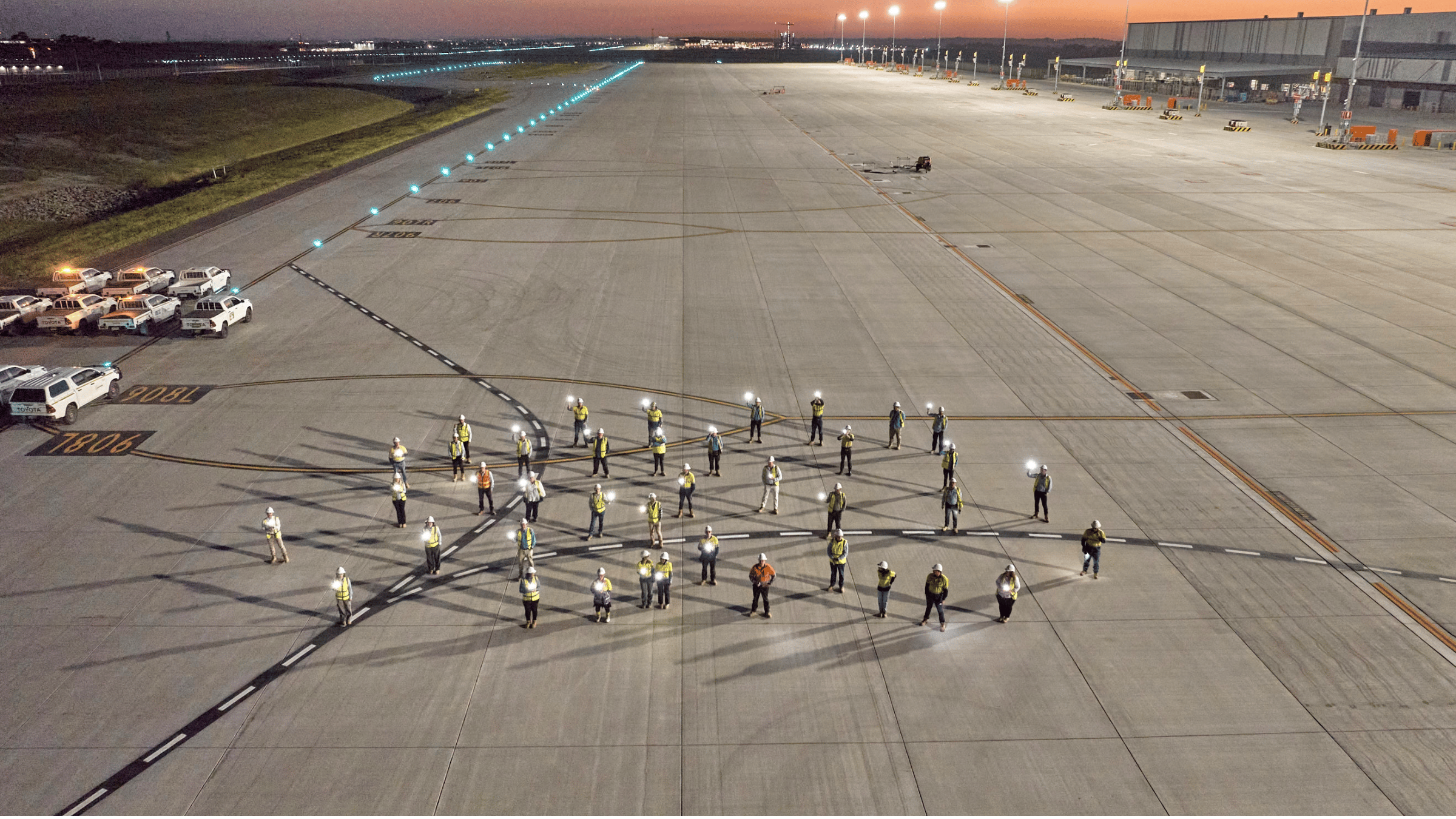
Practical completion has been achieved on Stage 1 Cargo Works at Western Sydney International (Nancy-Bird Walton) Airport (WSI), marking a significant milestone in the delivery of Sydney’s new 24-hour global gateway.
The project, delivered by the CPB Contractors and Acciona Joint Venture, was completed ahead of schedule and within budget, enabling WSI objective to commence cargo operations on Monday 27 July 2026.
Stage 1 Cargo Works involved the design and construction of WSI’s dedicated freight and cargo precinct, a key component of the overall airport development. Separate from the passenger terminal, the cargo precinct has been planned to enable early activation and to support freight, logistics and supply chain activity across the region.
Delivery of the project was undertaken by three specialist construction teams working in close coordination under a highly accelerated programme.
The civil and pavements team constructed approximately 150,000 m2 of aircraft pavement, along with associated taxiway connections, landside roads and heavy‑duty pavements designed to support freight vehicles accessing the precinct. This work also included the installation of extensive underground services, forming a complex network of critical infrastructure beneath the pavement and road surfaces.
In parallel, the building team delivered Block 2, a 45,000 m2 cold‑shell warehouse extending nearly half a kilometre in length and accommodating five individual tenancies. The team accommodated evolving tenant design requirements while maintaining the overall delivery programme. On completion, the cargo facilities provided a total net lettable area of 75,000 m2.
The third team was responsible for utilities and services, installing high and low‑voltage power, fibre‑optic communications, aeronautical ground lighting and a wide range of systems required to support live operations across the cargo precinct. Extensive testing and commissioning were completed to ensure the infrastructure is ready to support safe and reliable cargo operations.
The project was delivered within a compressed timeframe with changes to scope as tenants began leasing portions of the facility. These challenges were addressed through close collaboration, detailed planning and coordination across all teams.
Innovation and sustainability were embedded throughout delivery, with a strong focus on reducing environmental impact and improving safety outcomes. The use of slipform paving for aircraft pavements reduced materials use (including 14 km of steel forms), fuel consumption and labour hours.
Value engineering of the pavements and warehouse building further reduced concrete and steel volumes while maintaining performance requirements.
Strategic partnerships made the most of recycling and waste reduction, with metals, tyres, oils and textiles diverted from landfill. Alongside general recycling, a large amount of concrete waste was recycled by Boral and repurposed as road base on site.
With 1,243,258 hours in total labour, workforce participation outcomes exceeded targets:
- 63% local workers on the project (30% target)
- 33% of workforce comprised apprentices and learner workers (20% target)
Stage 1 Cargo Works continues our track record for delivering complex aviation infrastructure to the highest international standards, supporting long‑term economic and community benefits for Western Sydney.