
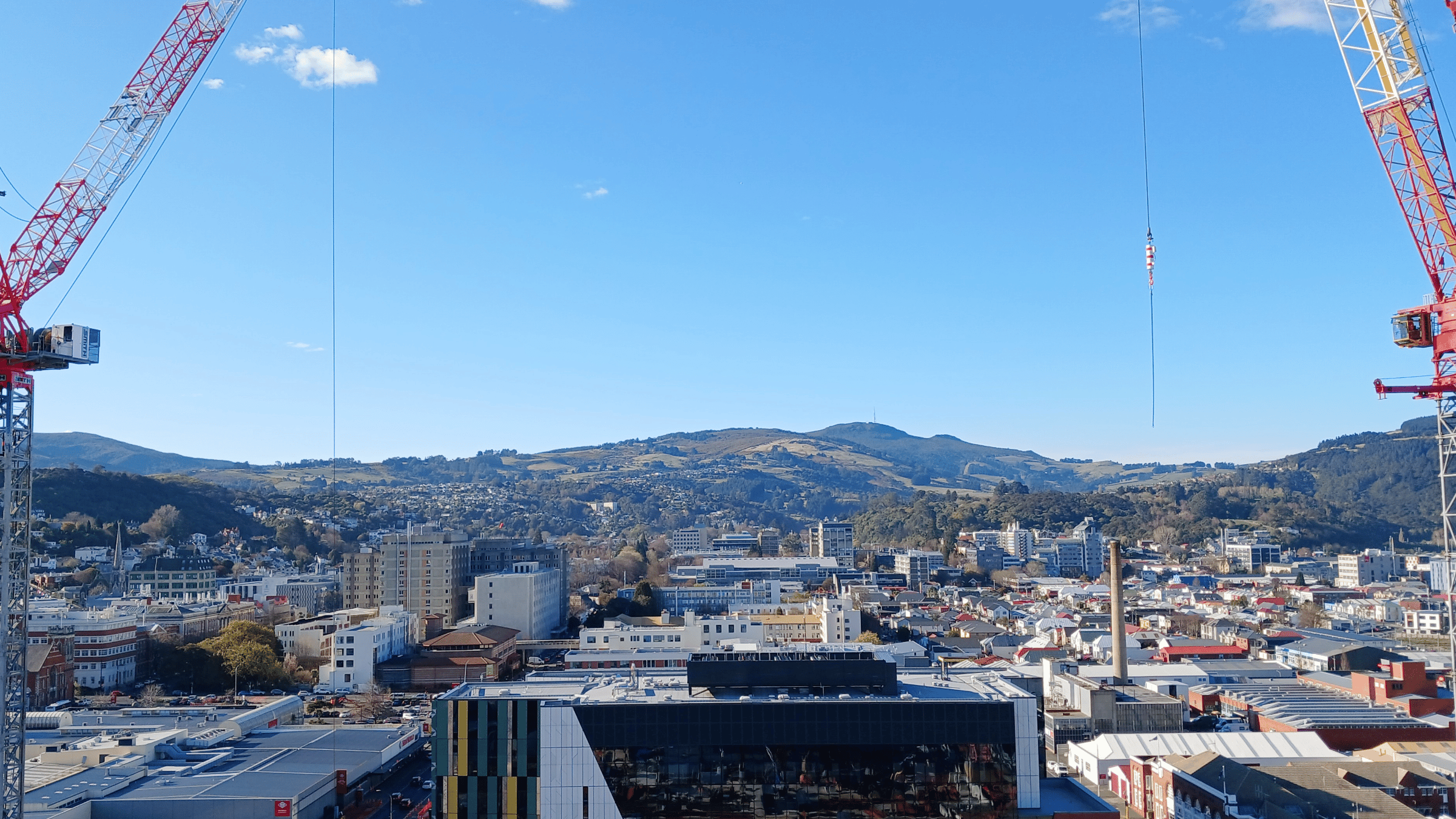
Three giant tower cranes are helping reshape the Dunedin skyline as work continues on the New Dunedin Hospital, New Zealand's largest health infrastructure project.
The cranes have become a familiar sight across the city, attracting attention from residents eager to follow the hospital's progress.
For tower crane operator Michael Schimanski, the view from above offers a unique perspective on a project that will support healthcare for generations to come.
But before his day begins, he must climb 184 steps up a 68-metre vertical ladder to reach his cab high above the construction site.
He says the three cranes are among the largest of their type in New Zealand, and it is unusual to see three luffing-jib tower cranes working together on a single project.
“To have three big luffers on the job in the South Island is like... big,” he says.
Many people compare a luffing-jib crane or “luffer” to a giant fishing rod.
Unlike a traditional tower crane with a fixed horizontal arm, the luffer’s jib can be raised and lowered, allowing it to work efficiently in tight spaces.
That’s one reason they are ideal for a complex inner-city project like the New Dunedin Hospital | Project Whakatuputupu.
The crane can work in a much smaller footprint because the jib angle can be adjusted depending on what’s happening around it, Michael says.
A second generation crane operator with more than 25 years’ experience in construction and lifting operations, he works as a crane site supervisor for Smith Crane and Construction, and as a relief crane operator.
He’s usually in the crane a couple of times a week.
His day starts at 6.30am. Before climbing to the cab, he carries out a series of inspections, checking the crane’s foundation, tower structure and key safety systems.
Once in the cab technology is a key enabler.
Modern tower cranes are highly computerised, continuously monitoring load weights, lifting capacities, wind conditions and the position of neighbouring cranes.
“The computer shows where the cranes are operating in relation to each other,” Michael says.
“It’s a pretty advanced system, everything is very structured.”
He’s also very reliant on the “rigger dogman”, a person stationed on site, whom he works closely with.
“They’re the eyes and the ears of the job. They tell you what needs to be done next and how it needs to be done.”
The dogman’s role typically includes attaching and securing loads to the crane hook, directing crane movements using radio communication and hand signals and ensuring lifts are carried out safely.
The tallest crane on site reaches about 123 metres to the top of the jib.
From his perch high above the city, Michael enjoys a perspective few people ever get to experience.
On clear days he can see vessels moving through Otago Harbour, activity out on the ocean and, recently, snow dusting the surrounding hills.
But it’s not just the view that keeps him coming back.
“It’s exciting to be part of something this significant,” he says.
“You can see the building changing every day and you know it’s going to make a real difference for the people who use it in the future.”
The Inpatient Building is scheduled to open for patient care in 2031. The neighbouring building, Outpatients | Whare Mātūtū, opens for patient care next month.
The cranes have become a familiar sight across the city, attracting attention from residents eager to follow the hospital's progress.
For tower crane operator Michael Schimanski, the view from above offers a unique perspective on a project that will support healthcare for generations to come.
But before his day begins, he must climb 184 steps up a 68-metre vertical ladder to reach his cab high above the construction site.
He says the three cranes are among the largest of their type in New Zealand, and it is unusual to see three luffing-jib tower cranes working together on a single project.
“To have three big luffers on the job in the South Island is like... big,” he says.
Many people compare a luffing-jib crane or “luffer” to a giant fishing rod.
Unlike a traditional tower crane with a fixed horizontal arm, the luffer’s jib can be raised and lowered, allowing it to work efficiently in tight spaces.
That’s one reason they are ideal for a complex inner-city project like the New Dunedin Hospital | Project Whakatuputupu.
The crane can work in a much smaller footprint because the jib angle can be adjusted depending on what’s happening around it, Michael says.
A second generation crane operator with more than 25 years’ experience in construction and lifting operations, he works as a crane site supervisor for Smith Crane and Construction, and as a relief crane operator.
He’s usually in the crane a couple of times a week.
His day starts at 6.30am. Before climbing to the cab, he carries out a series of inspections, checking the crane’s foundation, tower structure and key safety systems.
Once in the cab technology is a key enabler.
Modern tower cranes are highly computerised, continuously monitoring load weights, lifting capacities, wind conditions and the position of neighbouring cranes.
“The computer shows where the cranes are operating in relation to each other,” Michael says.
“It’s a pretty advanced system, everything is very structured.”
He’s also very reliant on the “rigger dogman”, a person stationed on site, whom he works closely with.
“They’re the eyes and the ears of the job. They tell you what needs to be done next and how it needs to be done.”
The dogman’s role typically includes attaching and securing loads to the crane hook, directing crane movements using radio communication and hand signals and ensuring lifts are carried out safely.
The tallest crane on site reaches about 123 metres to the top of the jib.
From his perch high above the city, Michael enjoys a perspective few people ever get to experience.
On clear days he can see vessels moving through Otago Harbour, activity out on the ocean and, recently, snow dusting the surrounding hills.
But it’s not just the view that keeps him coming back.
“It’s exciting to be part of something this significant,” he says.
“You can see the building changing every day and you know it’s going to make a real difference for the people who use it in the future.”
The Inpatient Building is scheduled to open for patient care in 2031. The neighbouring building, Outpatients | Whare Mātūtū, opens for patient care next month.